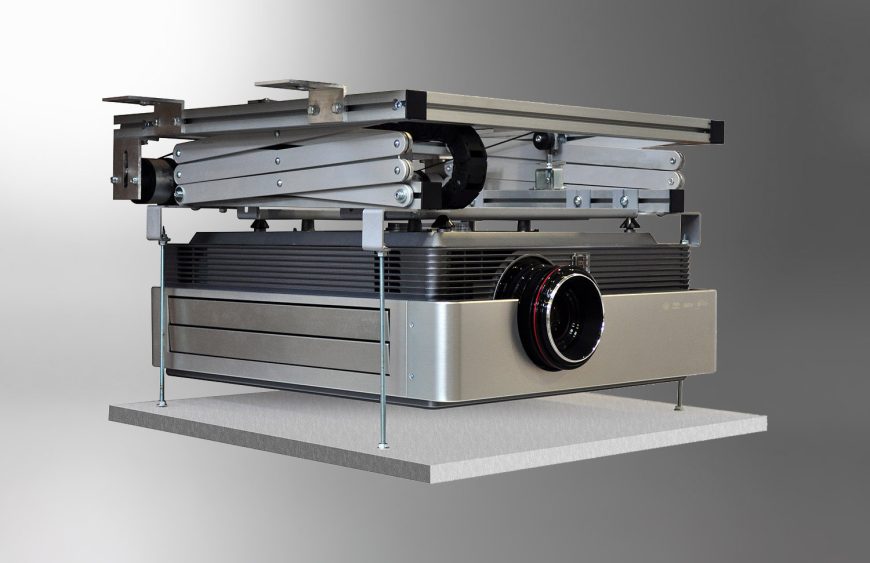
A recessed projector lift hides the projector inside the ceiling and lowers it on a remote when you want to watch. When you finish, it rises back up and sits flush with the ceiling, out of sight. The main question before you fit one is simple: how much depth do you need above the ceiling? This guide answers that, and covers what else the ceiling void needs.
What a recessed projector lift is
A recessed projector lift is a motorised mount fitted into the ceiling void. The projector sits inside the void behind a flap or panel. On a remote, the lift lowers the projector below the ceiling to project, then raises it back up and closes flush. It is the cleanest way to hide a ceiling projector, since nothing shows when the projector is off.
How much ceiling depth you need
The depth above the finished ceiling is the sum of three things:
- The projector’s height when retracted.
- The lift’s collapsed height from its spec sheet.
- Clearance for cables, connectors, and airflow.
As a rough planning figure, most recessed projector lifts need around 250 to 400 mm (about 10 to 16 inches) of clear depth above the finished ceiling. A slim projector on a compact lift can fit in roughly 200 mm. A larger projector, or a lift with a long drop, can need 400 mm or more.
Treat that as a bracket for early planning, not a specification. The exact minimum comes from the lift’s spec sheet plus your projector’s dimensions. Add them, with clearance, and you have your void depth.
What else the ceiling void needs
Depth is not the only thing to check.
- Structural support. The lift and projector must fix to a joist, a slab, or a strongback between joists. Never fix to plasterboard alone.
- Clear of services. The void has to be clear of ducts, wiring, and pipes at that spot.
- Heat. A projector in a closed void builds heat, so plan some airflow.
- Access. Leave a way to reach the unit for cleaning, filters, or service.
The drop is a separate measurement
Do not confuse the two vertical measurements. The depth above the ceiling holds the retracted projector and lift. The drop below the ceiling is how far the projector descends to clear the ceiling and project. Plan both: the void above, and the drop below for your throw and image.
Recessed lift, or another way to hide it
A recessed projector lift needs void depth and some building work, so it suits a planned or false ceiling. If you cannot recess the projector, a drop-down mount or a soffit can hide it instead. Our guide on how to hide a ceiling projector compares the options.
Tono projector lifts
Tono’s projector lifts lower the projector from the ceiling on a remote and raise it out of sight. Each comes with a spec sheet that gives the exact collapsed height and drop. To match a lift to your projector and ceiling void, contact Tono.
Frequently asked questions
How much space do you need above the ceiling for a projector lift?
Around 250 to 400 mm for most units, though it depends on the projector and the lift. Add the projector’s retracted height, the lift’s collapsed height, and clearance, then check against the lift’s spec sheet.
Can you fit a projector lift in a false ceiling?
Yes, if the void is deep enough and the lift can fix to solid structure above, not just the false-ceiling panels. Confirm the void depth and a fixing point first.
How far does a projector lift drop below the ceiling?
That varies by model, set by the drop you need to clear the ceiling. It is a separate figure from the depth above the ceiling, and the spec sheet lists it.
Does a recessed projector need ventilation?
Yes. A projector in a closed ceiling void builds heat, so plan airflow or a vent to let warm air escape.