Planning a hall or auditorium around retractable seating starts with one question: how much room does it take, open and closed? Retractable seating dimensions change completely between the two states, which is the whole point of the system. This guide explains the measurements that drive your floor plan, with typical figures and a worked example.
Extended and retracted: the two footprints
Retractable seating, also called telescopic seating, has two footprints.
- Extended, the rows step back and up in tiers, taking a deep footprint for the audience.
- Retracted, the rows fold under each other and stack flat against a wall, freeing the floor for another use.
A system that runs several metres deep when open can stack to a fraction of that when closed. That swing is why retractable seating suits multipurpose halls, where the same floor hosts a seated event one day and an open function the next.
The retractable seating dimensions that drive your plan
Five measurements shape the plan.
Row depth
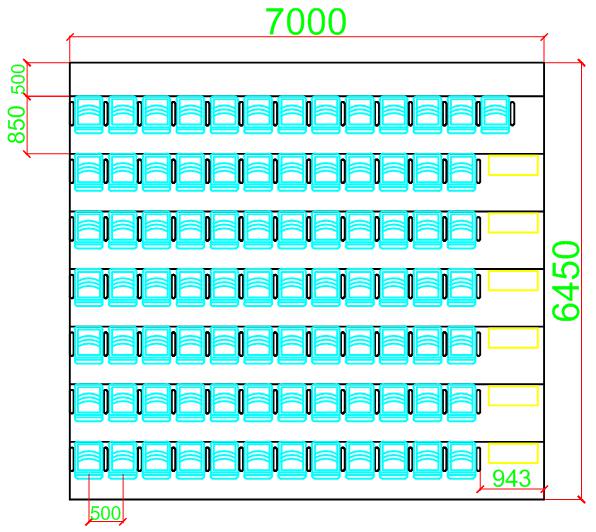
Each tier adds depth front to back, usually around 0.8 to 0.9 m per row. Multiply the row depth by the number of rows for the total extended depth. Eight rows at 0.9 m, for example, reach about 7.2 m deep.
Seat width and capacity
Each seat is roughly 0.45 to 0.55 m wide. Divide the available width by the seat width for seats per row, then multiply by the number of rows for total capacity.
Riser height
The riser is the step up from one row to the next, often 0.2 to 0.45 m. A taller riser gives better sightlines over the row in front, but it needs more ceiling height at the back.
Retracted (stacked) depth
When closed, the rows nest together. The stacked depth is a small fraction of the extended depth, often around a tenth, so a deep bank of seating folds back to roughly a metre.
Aisles and exits
Add code-required aisles and exit clearances around the seating. These come from local safety rules, not from the seating itself, so check them early.
A worked example
Take a hall with a bank of 10 rows, each 0.9 m deep:
- Extended depth: about 9 m.
- Retracted depth: roughly 1 m against the wall.
- Capacity: at 0.5 m per seat across a 12 m width, that is 24 seats per row, or about 240 seats.
These are guideline figures. The exact numbers come from the manufacturer’s drawings for the model you choose.
Don’t forget ceiling height and floor
The back row sits highest, so check the ceiling clears a standing person on the top tier. Confirm the floor is level and rated for the loaded weight of a full system, because a packed bank of seating is heavy.
For architects: get the CAD drawing
If you are drawing the space, work from the manufacturer’s CAD block. A DWG or Revit file gives the exact extended and retracted footprints, so your plan matches the real product. Ask the supplier for the drawing before you finalise the layout.
Tono retractable seating
Tono’s retractable seating system folds away to free your floor, then extends into tiered rows when you need them. For how the system works and where it suits, see our retractable seating system guide. To plan a layout and get exact retractable seating dimensions for your hall, contact Tono.
Frequently asked questions
How much space does retractable seating need?
It needs a deep footprint when extended, around 0.9 m per row, and a shallow one when retracted, often a tenth of that. A 10-row bank runs about 9 m deep open and roughly 1 m closed.
How deep is retractable seating when extended?
Multiply the row depth, usually 0.8 to 0.9 m, by the number of rows. Eight rows reach about 7 m, and ten rows about 9 m.
How much does retractable seating stack to when retracted?
The rows nest together to a small fraction of the open depth, often around a tenth, so a deep bank folds back to roughly a metre against the wall.
How many rows can retractable seating have?
It varies by model and ceiling height, since each row rises higher than the last. The manufacturer’s drawings give the maximum for a given height.