
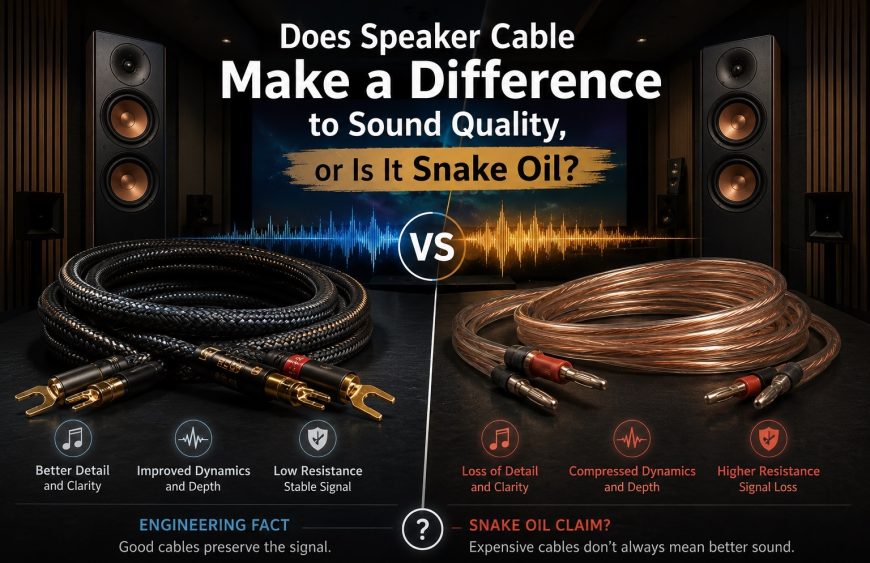
Does speaker cable make a difference to sound quality? The honest answer is both. It does matter, but only up to a point, and not where the expensive marketing says. Get the basics right and the cable does everything it can for the sound. Spend beyond that, and you are mostly paying for snake oil. Here is the line between the two.
What actually affects the sound
Three things about a speaker cable genuinely change what you hear.
Gauge and length
Wire has resistance, and thin wire over a long run loses some of the signal as a voltage drop. Too much resistance also lowers the damping factor, which can leave the bass sounding loose. This is why gauge matters. As a rough guide, 16 AWG suits short runs, while 14 or 12 AWG suits longer runs or 4-ohm speakers. Our speaker wire gauge guide shows how to match gauge to your run.
Connections and polarity
A loose or corroded connection degrades the sound more than any cable upgrade. Strip the wire cleanly, make a tight connection, and keep the polarity the same at both ends. Our guide on connecting speaker cables covers this.
Decent copper and insulation
You want clean copper, such as oxygen-free copper, with solid insulation. For an in-wall run, the cable should be CL2-rated for safety. Beyond this, the material makes little audible difference.
Where the snake oil starts
Once a cable is thick enough for the run and well connected, it is doing its job. The expensive tier above that is where the claims outrun the evidence, such as directional cables, cryogenically treated wire, exotic-metal conductors, and cables costing hundreds or thousands.
In controlled, level-matched, blind listening tests, these cables show no reliable audible difference against a well-made ordinary cable. The differences people report tend to disappear once they cannot see which cable is playing. That points to expectation rather than the cable itself.
There are edge cases. Cable capacitance and inductance can matter on very long runs, or with unusual speakers such as electrostatics. For a normal home system, they do not.
Being fair to both sides
Many experienced listeners sincerely believe they hear a difference, and they are not fools. But the test that settles it is a blind, level-matched comparison, and the expensive-cable claims do not survive it. What does survive it is gauge, length, and connection quality. Those are worth getting right.
So, does speaker cable make a difference?
Match the gauge to your run length and speaker impedance. Make clean, tight connections. Use decent copper, CL2-rated if it goes in a wall. Then stop. Past the point of an adequate, well-made cable, more money buys less and less, down to nothing.
What Tono builds
Tono’s speaker cables are built around the things that actually affect the sound: the right gauge, oxygen-free copper, and a CL2-rated in-wall option. Not exotic claims, just a cable that does its job. Match one to your run with the gauge guide, or contact Tono for help choosing.
Frequently asked questions
Do expensive speaker cables sound better?
Not once the cable is thick enough for the run and well connected. Beyond that point, blind tests show no reliable difference, however high the price.
Does thicker speaker cable improve sound?
Only if the thinner cable was too thin for the distance. Moving to a heavier gauge on a long run can help; going thicker than needed does nothing.
Is directional speaker cable real?
No. There is no evidence that a speaker cable sounds different one way round. The signal to a speaker is alternating current, which flows both ways.
Do speaker cables need burn-in?
No. There is no measured or blind-tested evidence that a speaker cable changes its sound with use.