
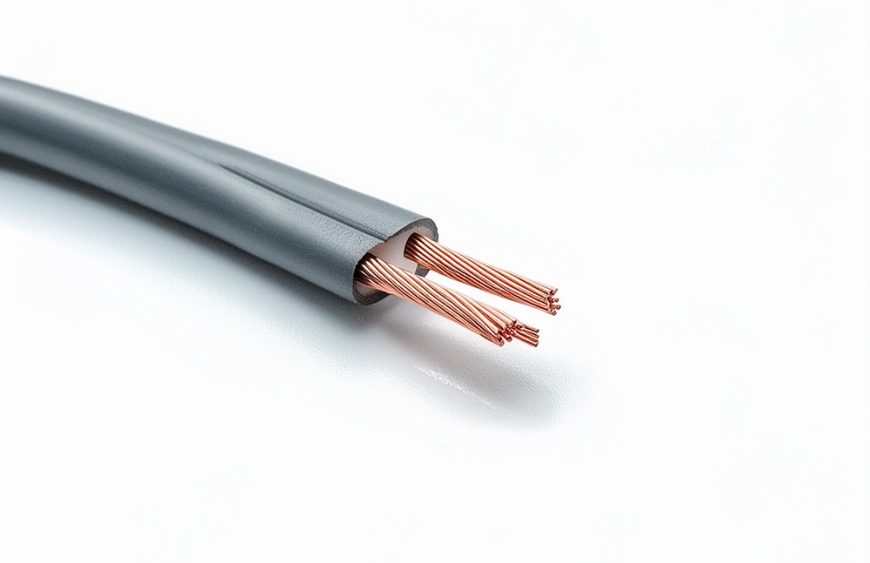
Home theatre sound depends on speaker placement, room acoustics, and the components you choose — but the cable connecting your amplifier to your speakers matters more than most buyers realise. Not for the reasons audiophile marketing claims, but for measurable, practical reasons: resistance, signal loss over distance, and safe in-wall installation.
This guide walks through how to choose the right speaker cable for a home theatre system: what gauge to use, how length affects the choice, what changes when you route cable inside walls, and the mistakes that cost installers time and money. By the end, you’ll know exactly which cable specification fits your setup.
Does speaker cable actually matter for home theatre?
Yes — but only on the factors that can be measured. Three properties of a speaker cable affect what you hear:
- Gauge (thickness): A thicker conductor has lower electrical resistance. Lower resistance means less signal loss between the amplifier and the speaker, especially over longer runs.
- Conductor material: Oxygen-free copper (OFC) maintains conductivity better than copper-clad aluminium (CCA) and resists corrosion over time. For a system you expect to keep for a decade, OFC is the practical choice.
- Jacket and insulation: For cable run in open air, almost any jacket works. For cable run inside walls, the jacket must meet fire-safety codes — this is non-negotiable, not a preference.
What does not meaningfully affect home theatre sound: exotic conductor metals, cable directionality, expensive connectors beyond a properly terminated banana plug or spade. If a cable’s marketing leans on those claims, you’re paying for the marketing, not the performance.
What gauge speaker wire do you need for home theatre?
Gauge is measured in AWG (American Wire Gauge). Counterintuitively, lower numbers mean thicker wire. For home theatre, the two practical choices are 14 AWG and 16 AWG. The right one depends on cable run length, speaker impedance, and how much power the amplifier delivers.
| Gauge | Recommended for | Max run length (8Ω speakers) | Max run length (4Ω speakers) |
|---|---|---|---|
| 16 AWG | Short runs, standard impedance speakers, surround and height channels | Up to ~24 ft / 7.5 m | Up to ~12 ft / 3.5 m |
| 14 AWG | Long runs, low-impedance speakers, high-power channels, in-wall installations | Up to ~40 ft / 12 m | Up to ~20 ft / 6 m |
| 12 AWG | Very long runs, outdoor speakers, high-power commercial setups | Beyond 40 ft / 12 m | Beyond 20 ft / 6 m |
The rule behind the table: keep total cable resistance below 5% of the speaker’s impedance. For 8Ω speakers, that’s 0.4Ω of cable resistance; for 4Ω speakers, 0.2Ω. Thicker wire and shorter runs both keep you under that threshold.
If you’re not sure of your speaker impedance, check the rear panel or the spec sheet — most home theatre speakers are 6Ω or 8Ω, but in-wall and architectural speakers are often 4Ω.
5.1, 7.1, and Atmos: cable needs by channel
Not every channel in a home theatre system carries the same load, so the cable specification can vary by channel. In practice, most installers use one gauge for the whole system to simplify procurement — but understanding the per-channel logic helps you decide whether to mix.
- Front left, centre, right (L/C/R): These carry the most energy in any home theatre mix — dialogue, music, and most directional effects. Use 14 AWG for runs over 15 ft or for any in-wall routing.
- Surround channels (rear left/right, side left/right): Lower power demand. 16 AWG is sufficient for runs under ~25 ft.
- Atmos height and ceiling channels: Low power demand, but cable runs are often long because the cable travels up and across the ceiling. 14 AWG is the safer default for in-ceiling Atmos installations.
- Subwoofer: A subwoofer does not use speaker cable. It connects via a shielded LFE (RCA) cable from the AV receiver’s subwoofer output. This is a common point of confusion — speaker wire is for passive speakers driven by an amplifier; the sub has its own amplifier built in.
Run length: how far is too far?
Cable run length is the single biggest factor that pushes you from 16 AWG to 14 AWG. Long runs add resistance, and resistance saps power before it reaches the speaker. The longer the run, the thicker the cable needs to be to compensate.
A practical way to think about it: measure the actual cable path, not the straight-line distance. Cable routed through walls, around door frames, and along skirting boards is typically 30–50% longer than the room measurement suggests. Always add 10–15% extra length for termination slack.
If a single run exceeds ~50 ft / 15 m, step up to 12 AWG regardless of channel. At that length, even 14 AWG starts to lose audible energy on low-impedance speakers.
In-wall vs in-room: what changes
Cable run inside walls, ceilings, plenums, or conduits is governed by fire-safety codes, not preference. The cable’s jacket must be rated to limit flame spread and smoke generation in a structural cavity. Standard “lamp cord” style speaker wire is not rated for this and is non-compliant in most jurisdictions.
The ratings to look for:
- CL2 / CL3: The most common in-wall ratings for residential speaker cable. CL3 carries a slightly higher voltage rating than CL2 but both are acceptable for home theatre use.
- CMP (plenum): Required when cable runs through air-handling spaces above suspended ceilings in commercial buildings. Rarely needed in residential installations.
- Outdoor / direct-burial: A separate category for cable run outside, in conduit, or buried underground.
If a speaker cable does not state a fire rating on the jacket print or in its specifications, assume it is not rated and use it only for in-room runs (along the floor, behind furniture, inside cable raceways). For any cable routed inside a wall or ceiling, use a CL2 or CL3-rated product.
Banana plugs, spades, or bare wire?
How you terminate the cable affects reliability and ease of service — not sound quality, in any measurable way. The three options:
- Bare wire: Strip 1 cm of insulation, twist the strands, insert into the binding post. Free, fast, works fine. Downside: copper oxidises over time, increasing contact resistance. Re-strip and re-terminate every few years on permanent installations.
- Banana plugs: The cleanest termination. Plug-and-unplug connection makes future service easy. Best for in-wall installations where you may need to disconnect speakers without re-stripping cable. Choose plugs that screw or crimp onto the wire, not solder.
- Spade lugs: Used with binding posts that have a flat contact surface. Common in high-end amplifiers. Mechanically secure, but less convenient than bananas for typical home theatre receivers.
For a home theatre system you intend to keep for years, banana plugs at both ends justify the small extra cost.
Common mistakes to avoid
- Using non-rated cable inside walls. The most serious mistake — it’s a code violation and a fire risk, not just a quality issue.
- Mixing gauges mid-run. Joining 14 AWG to 16 AWG creates a resistance step that defeats the purpose of choosing the thicker wire.
- Reversing polarity. Speaker cable has a positive and negative conductor, marked by a stripe, ridge, or text print. Reversing polarity on one speaker causes phase cancellation — the soundstage collapses and bass weakens. Check at every termination.
- Running speaker cable parallel to mains power. Induced noise from AC wiring can leak into the audio signal over long parallel runs. Cross power cables at 90 degrees where they must intersect; keep parallel separation of at least 15 cm.
- Under-specifying for future upgrades. If you’re running cable inside walls now, install the thicker gauge even if your current setup doesn’t need it. Re-pulling cable later costs far more than the upgrade now.
- Skipping the slack. Add 30–60 cm of extra cable at each end. Future repositioning, replacement, or re-termination becomes trivial; without slack, it means re-pulling the entire run.
Choosing the right TONO cable for your setup
For most home theatre installations, the choice comes down to two practical scenarios:
- 5.1 setup, in-room runs under 25 ft, standard 8Ω speakers: 16 AWG is sufficient for all channels. Choose a CL2-rated jacket if any run touches a wall cavity, even briefly.
- 7.1 or Atmos setup, longer runs, in-wall or in-ceiling routing, or any 4Ω speaker: Use 14 AWG throughout. Standardising on one gauge simplifies installation and stocking.
The TONO Pro CI Series speaker cable is built for both scenarios. Available in 14 AWG and 16 AWG with oxygen-free copper conductors, it’s designed for custom-installation work — including concealed, in-wall, and conduit routing in residential home theatre and multi-room audio projects. See the full TONO speaker cable range for additional gauge and length options, or request a quote for project pricing.
Frequently asked questions
Is 14 AWG or 16 AWG better for home theatre?
14 AWG is better for runs over 25 ft, for 4Ω speakers, and for any in-wall installation. 16 AWG is sufficient for shorter runs to standard 8Ω surround and height speakers. When in doubt, use 14 AWG — the small added cost outweighs any performance compromise.
Can I use regular speaker wire inside walls?
No. Cable run inside walls, ceilings, or conduits must carry a fire-safety rating such as CL2 or CL3. Standard unrated speaker wire is a code violation in most jurisdictions and a genuine fire risk. Always use CL2 or CL3-rated cable for any concealed run.
Does speaker cable length affect sound quality?
Yes, but only beyond certain thresholds. Below ~25 ft on 8Ω speakers with 16 AWG cable, the effect is inaudible. Longer runs add resistance that reduces damping factor and can attenuate high frequencies. Use thicker gauge to compensate on long runs.
Do expensive speaker cables make a difference?
Beyond the basics — adequate gauge, oxygen-free copper, proper termination, correct in-wall rating — independent listening tests have not consistently shown audible improvements from premium speaker cables. Spend the budget on speakers, amplification, and room acoustics first.
What cable do I need for Atmos ceiling speakers?
Use 14 AWG CL2 or CL3-rated cable. Atmos ceiling channels have low power demand but typically need long runs across the ceiling cavity, where in-wall fire ratings are required.
Do I need special cable for the subwoofer?
Yes. A powered subwoofer uses a shielded LFE (RCA) cable from the AV receiver’s subwoofer output, not speaker wire. Speaker cable is only used for passive speakers driven by the receiver or amplifier.