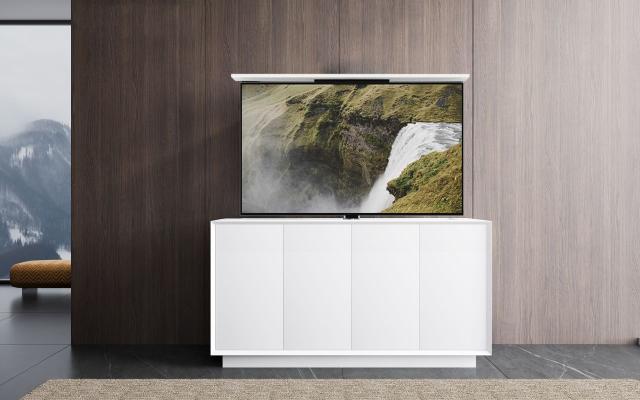
Getting the TV lift cabinet dimensions right is the difference between a clean pop-up install and a TV that jams or rattles. Build the opening too tight and the TV catches. Build it too loose and the lid never sits flush. This guide explains how to size every part of the cabinet around a pop-up TV lift.
Start with the lift’s spec sheet
The most important step comes first: get the exact figures from your chosen lift’s spec sheet. Every model has its own collapsed height, travel, and footprint. This guide gives you the method and the typical clearances for the main TV lift cabinet dimensions, but the lift’s own numbers always win.
The four TV lift cabinet dimensions that matter
A pop-up TV lift cabinet comes down to four measurements.
Opening width
This is the slot the TV rises through, and the internal width of the cabinet. Take your TV’s width, then add clearance on each side:
- About 20 to 25 mm (one inch) of free space on each side of the TV.
- Extra room if a floating lid or trim sits around the TV.
As a rough guide, a 55-inch TV is around 1,220 mm wide, a 65-inch around 1,450 mm, and a 75-inch around 1,660 mm. Always measure your actual TV.
Internal height
The cabinet must hold the TV and the lift when both sit down. Add the TV’s height to the lift’s collapsed height, then add clearance. Check that the lift’s travel still raises the screen high enough above the cabinet top.
Internal depth
Measure the TV’s depth, including any mounting bracket on the back. Add the lift mechanism’s depth and room for the cables to flex. Leave a gap so the screen never touches the back panel as it moves.
Lid opening
The lid is the panel the TV passes through. A floating lid travels up with the TV, while a fixed top has a cut slot. Size the slot to the TV plus the side clearance.
Clearances and tolerances
Do not build to the exact size of the TV. Leave room on every side so the screen moves freely and the cabinet can flex with temperature and humidity. Account for a VESA bracket that sticks out the back, and leave slack for the cables that move with the TV.
Ventilation
A TV sealed inside a cabinet builds heat, which shortens its life. Add vents, a rear opening, or a small gap so warm air escapes. This matters most when the TV stays on for long sessions.
Weight and the base
The cabinet base carries the lift and the TV together. Build it strong, and fix the lift to a solid, level base as the maker specifies. A flimsy base lets the lift twist and the TV wobble.
Power and cables
Plan a power outlet inside the cabinet for the lift and the TV. Route the cables with enough slack to follow the TV up and down, and tidy them so nothing snags as the lift moves.
Build around a Tono pop-up TV lift
Tono’s pop-up TV lifts come with the spec sheets you need to size a cabinet, with models rated by TV size and weight. Pick the lift first, take its dimensions, then build the cabinet to suit. See the full TV lift range or the buyer’s guide, or contact Tono for the right model.
Frequently asked questions
What size cabinet do I need for a 65-inch TV lift?
Allow for a TV around 1,450 mm wide, plus about 25 mm clearance on each side, plus the lift’s collapsed height and depth. Confirm against your lift’s spec sheet.
How much clearance should I leave around the TV?
About 20 to 25 mm on each side and at the top, and 25 to 50 mm at the back for the mount and cables. The TV should never touch the cabinet as it moves.
Does a TV in a lift cabinet need ventilation?
Yes. A sealed cabinet traps heat and shortens the TV’s life. Add vents or a rear opening so warm air can escape.
Can I build my own TV lift cabinet?
Yes. Buy the lift, follow its spec sheet for the dimensions, and build the cabinet around it. Get the opening width, internal height, and depth right, and leave clearance on every side.