
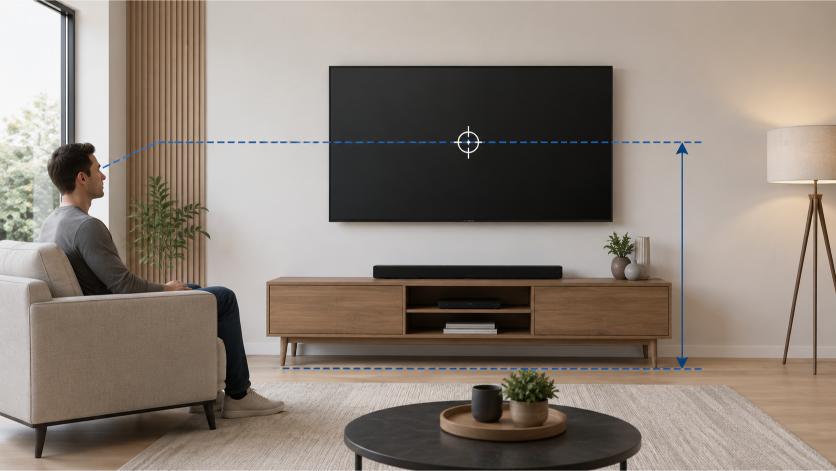
TV mounting-height calculator
Get the exact height for your TV size and seat — instantly.
Measure floor-to-eyes while sitting where you watch. Standard sofa ≈ 42".
Mount the bottom of the TV at
—
from the floor
How High Should a TV Be Mounted? Height Chart by Size + Simple Formula
Quick answer: Mount your TV so the centre of the screen sits at seated eye level — about 42 inches (107 cm) from the floor for a standard sofa. Because larger TVs are taller, the bottom of the screen sits lower as the size goes up. Use the chart below for your exact size, or the one-line formula to calculate any setup.
This is the single most common reason a great TV feels “off” in a room: it’s mounted too high. The fix is simple ergonomics — and where your room won’t allow the ideal height (above a fireplace, in a bedroom, in a boardroom), the right mount or lift solves it.
The one rule that matters: centre the screen at eye level
When you’re seated and relaxed, your line of sight is roughly level or slightly downward. The centre of the screen should meet that line. For most people on a standard sofa, seated eye level is 40–45 inches (102–114 cm) from the floor, so 42 inches (107 cm) to the centre of the screen is the reliable target.
Everything else — the height to the bottom of the TV, the bracket position — is just arithmetic from that one number.
The formula (works for any TV and any seat height)
Height to bottom of TV (from floor) = Seated eye level − (TV height ÷ 2)Two inputs:
- Seated eye level: measure from the floor to your eyes while sitting where you normally watch (typically ~42 in / 107 cm).
- TV height (not the diagonal): for a 16:9 TV, screen height ≈ diagonal × 0.49. So a 65″ TV is about 32 in (81 cm) tall.
Worked example for a 65″ TV at 42 in eye level: 42 − (32 ÷ 2) = 26 in (66 cm) to the bottom of the screen.
TV mounting height chart by size
Centre of screen stays at ~42 in (107 cm) for every size — that’s the constant. What changes is how far the bottom edge sits from the floor.
| TV size (16:9) | Screen height | Centre of screen (eye level) | Bottom of TV from floor |
|---|---|---|---|
| 43″ | ~21 in / 53 cm | 42 in / 107 cm | ~31 in / 79 cm |
| 50″ | ~24.5 in / 62 cm | 42 in / 107 cm | ~30 in / 76 cm |
| 55″ | ~27 in / 69 cm | 42 in / 107 cm | ~28.5 in / 72 cm |
| 65″ | ~32 in / 81 cm | 42 in / 107 cm | ~26 in / 66 cm |
| 75″ | ~37 in / 94 cm | 42 in / 107 cm | ~23.5 in / 60 cm |
| 85″ | ~42 in / 106 cm | 42 in / 107 cm | ~21 in / 53 cm |
| 98″–100″ | ~49 in / 124 cm | 42 in / 107 cm | ~18 in / 46 cm |
Adjust up or down by the difference between your seat’s eye level and 42 in. Higher sofa or bar stools? Raise everything by the same amount.
Don’t forget viewing distance and angle
Height is half the comfort equation; distance is the other half. As a working rule, sit about 1.5–2.5× the screen’s diagonal away, and keep the horizontal viewing angle within roughly 30–40° (the SMPTE and THX guidelines). Quick reference:
| TV size | Comfortable viewing distance |
|---|---|
| 55″ | ~7–9 ft / 2.1–2.7 m |
| 65″ | ~8–11 ft / 2.5–3.3 m |
| 75″ | ~9–12 ft / 2.8–3.8 m |
| 85″ | ~10–14 ft / 3.2–4.3 m |
If you sit much closer than the low end, mount slightly lower; much farther, you have a little more latitude to raise it.
Mounting height by room
Living room. The 42 in / eye-level rule applies directly. This is where getting it right matters most.
Bedroom. You’re usually reclined or propped up, and often viewing from the foot of the bed, so the TV goes higher — 48 to 60 in (122–152 cm) to the bottom — with a downward tilt of 10–15° so the screen faces you. A tilting or full-motion mount is essential here.
Kitchen / under-cabinet. Sightlines are usually standing, so mount at standing eye level and angle down. Compact, swivel, or drop-down solutions work best in tight kitchens.
Above a fireplace. Almost always too high for comfortable viewing and can expose the panel to heat. If it’s the only option, use a pull-down or motorised mount that brings the screen down to eye level when you watch and tucks it away when you don’t — rather than craning your neck.
Boardroom / commercial. For standing presentations, raise the centre to ~48–52 in; for seated meeting rooms, keep eye-level logic. Motorised display lifts and wall mounts let one room serve both modes.
The tilt rule (for when you must mount high)
Every extra foot (30 cm) you mount above seated eye level adds neck strain. Compensate with roughly 5–10° of downward tilt per foot of extra height. A tilting bracket turns an unavoidable high mount into a watchable one — but tilt is a workaround for height, not a substitute for getting the height right.
When your ideal height isn’t possible — choose the right hardware
Most “my TV is too high” problems are really hardware problems. Match the fix to the wall:
- Wall is fine, height is fine → a slim fixed or tilting TV wall mount holds the screen exactly at eye level.
- Off-centre seating, or you watch from more than one spot → a full-motion / articulating mount lets you angle the screen to the seat.
- Above a fireplace, or you want eye-level on demand → a motorised TV wall mount drops the screen to the perfect height at the touch of a button and lifts it back up.
- No good wall at all, or you want the TV hidden → a ceiling TV lift brings the screen down from the ceiling. Use a flip-down ceiling lift for low ceilings or a drop-down ceiling lift to lower the screen into the room.
- Renting, or can’t drill → a TV floor stand sets the height without touching the wall.
- Large 85″–100″ panels → make sure the mount is rated for the weight; see our large-TV wall mounting guide and weight-limit reference.
Not sure which mount fits your wall and TV? Talk to a Tono specialist — we’ll match the height, the wall type, and the screen size for you.
Common mounting-height mistakes
- Mounting at standing height because it looks right on the wall. You watch sitting down — measure from the seat.
- Centring the bracket instead of the screen. Brackets sit behind the panel; always work from the centre of the screen.
- Following a fixed “bottom of TV” number for every size. A 55″ and an 85″ need different bottom heights to share the same centre.
- Mounting above the fireplace without a pull-down mount. Comfortable for no one.
- Ignoring cable management. Plan recessed cabling or a cable concealment path before you drill.
Frequently asked questions
How high should a 65-inch TV be mounted? About 26 inches (66 cm) from the floor to the bottom of the screen, which puts the centre at seated eye level (~42 in / 107 cm).
How high should a 55-inch TV be mounted? Around 28.5 inches (72 cm) to the bottom of the screen for a standard sofa, keeping the centre at ~42 in / 107 cm.
How high should a 75-inch TV be mounted? About 23.5 inches (60 cm) to the bottom edge — larger screens sit lower so the centre stays at eye level.
What is the ideal TV height from the floor? The centre of the screen at ~42 inches (107 cm), matching seated eye level on a standard sofa. Adjust to your own seat height.
Is it bad to mount a TV too high? Yes — a high mount forces you to tilt your head up, causing neck strain over time. If you must mount high (e.g. above a fireplace), use a tilting or motorised pull-down mount to bring the screen to eye level.
How high should a TV be in a bedroom? Higher than a living room — 48 to 60 inches (122–152 cm) to the bottom — with a 10–15° downward tilt, because you watch reclined and often from the foot of the bed.
Related Articles
Recent Posts
- How Can You Improve Productivity Through Better Conference Room Design?
- Recessed Projector Lift: How It Works and the Ceiling Depth You Need
- Does Speaker Cable Make a Difference to Sound Quality, or Is It Snake Oil?
- Do You Need a Watch Winder?
- Electric Wardrobe Lift with Remote Control: How It Works and What It Costs