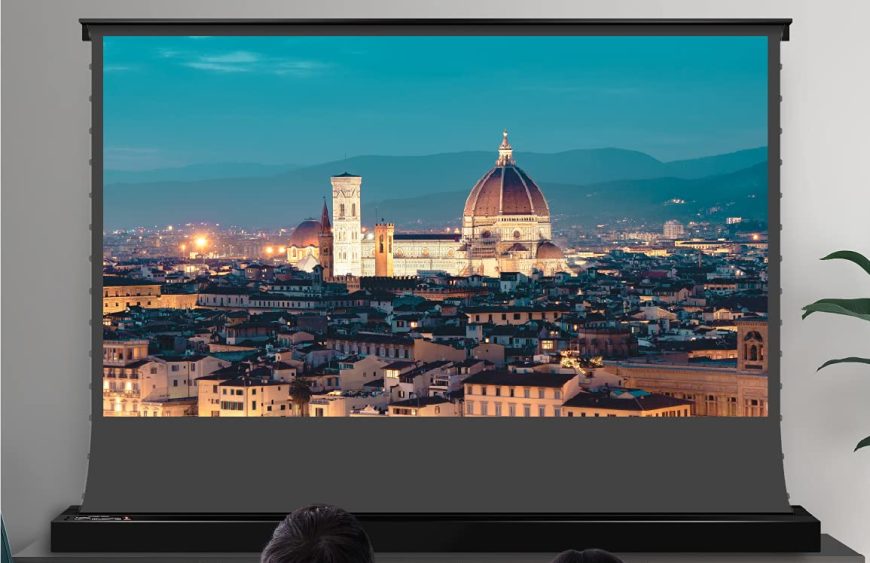
A floor rising projector screen solves the hardest problem in a modern living room: ambient light. The screen does not drop from the ceiling. Instead, it rises from a slim floor cabinet at the touch of a button, then sinks away when you finish. Add an ALR (ambient light rejecting) surface and a UST projector, and you get a daylight-ready home cinema. There are no holes in the wall and no cables across the ceiling.
This guide explains how a floor rising projector screen works. It covers the ALR surface, the right projector, and how to choose a size. Throughout, it uses the verified specs of the Tono Floor Rising ALR Projector Screen as a reference.
What is a floor rising projector screen?
A floor rising projector screen is a motorised screen that lives in a floor cabinet. It rises upward when you switch it on. Nothing mounts on your ceiling or wall. So it suits rooms where drilling is not an option, such as rentals, glass walls, or finished interiors.
The Tono unit is free-standing and needs no installation. You set it on the floor, slide it into place, and move it later if your layout changes. A silent tubular motor drives a double V-shaped bracket. The bracket lifts the fabric with even force, which keeps the surface flat and prevents stretching.
Several search terms describe the same product. A rising projector screen, an electric floor rising screen, and a motorized floor rising projector screen all point to this one category.
Why the ALR surface matters
ALR stands for ambient light rejecting. An ALR projector screen uses a layered optical surface. It reflects the projector’s light toward your eyes. At the same time, it absorbs light from windows and lamps. You get strong contrast and deeper blacks in a bright room, where a plain white screen would wash out.
The Tono surface rejects more than 97% of ambient light at 0.6 gain. It holds a 170° wide viewing angle, so the picture stays even across a sofa. The screen is ready for 4K and 8K Ultra HD, supports HDR, and handles Active 3D.
ALR vs CLR: what is the difference?
Buyers often compare ALR and CLR. ALR is the umbrella term for any ambient light rejecting screen. CLR, or ceiling light rejecting, is a specific ALR surface tuned for UST projectors that sit below the screen. A floor rising UST screen uses this kind of surface, because the projector throws light upward from close range.
Built for ultra short throw (UST) projectors
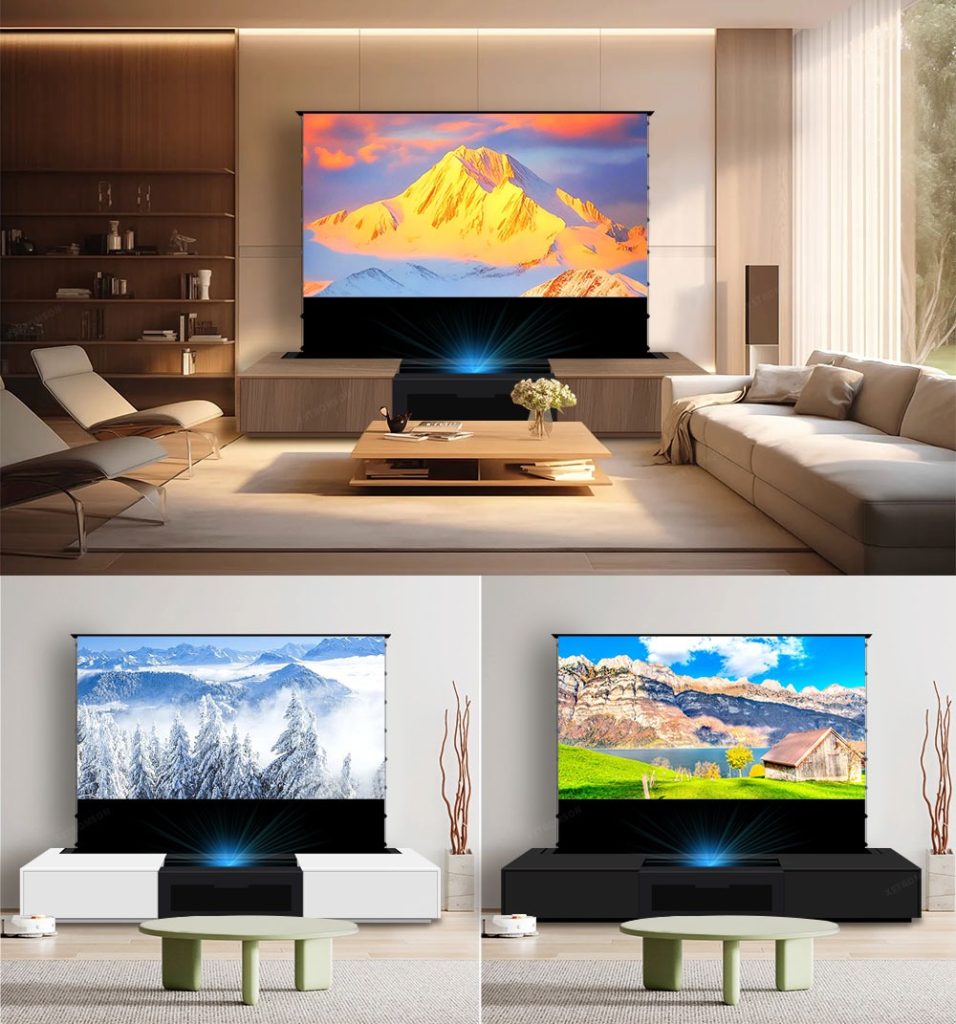
A floor rising projector screen is made for a UST projector. The projector sits on the cabinet or console directly below the screen. It throws a large image from only a few centimetres away. That removes the long ceiling run and the distance a traditional long throw projector needs.
This pairing is the reason the category exists. The screen rises into the exact spot the UST projector expects. The ALR surface rejects overhead light. The whole setup then disappears when you are done. If you run a ceiling-mounted projector instead, see the UST ALR in-ceiling tab-tensioned screen or the full projector screen range.
Tab-tensioned and wrinkle-free
A flat screen is essential for a sharp image. This is where a tab-tensioned design earns its place. Tabs along both edges pull the fabric tight and hold it square. The surface then stays free of waves and curls. A screen without tensioning can ripple at the edges. That distorts the picture, and it shows clearly on a bright UST image.
The Tono screen is tab-tensioned across its full height. The double V-shaped bracket also applies uniform force as it rises. Together they keep the surface taut every time. That protects both the image and the life of the fabric.
What size do you need?
Size depends on your viewing distance. A common rule places your main seat about 1.2 to 1.5 times the screen width away. A larger room can take a larger screen. The Tono floor rising range covers 92 to 120 inches, and the unit is customizable.
For most living rooms, a 100-inch or 120-inch screen hits the sweet spot. Measure your viewing distance first. Then pick the largest size that still feels comfortable. To compare surfaces and panel types in more depth, read our guide on how to choose a projector screen.
Floor rising vs ceiling and wall screens
A ceiling or wall retractable screen needs fixed mounting. It also needs a power point overhead and often a cable run to the projector. A floor rising projector screen removes all of that. It stands on the floor, plugs into a normal socket, and hides inside its cabinet between sessions.
So the floor rising design suits rooms where you cannot drill. It also fits glass or feature walls, and homes that should look untouched when the cinema is off. The trade-off is floor space for the cabinet. Tono keeps the cabinet slim to limit that footprint.
What to look for before you buy
A few specs separate a quality floor rising projector screen from a basic one. Use this checklist:
- Ambient light rejection and gain. Look for a high rejection figure and a UST-friendly gain. The Tono screen rejects over 97% of ambient light at 0.6 gain.
- Viewing angle. A wide angle keeps the image even across a sofa. Tono rates 170°.
- Motor and drive. A silent tubular motor with an even-force bracket protects the fabric and stays quiet.
- Control and triggers. The Tono A8 system ships with an 868 MHz remote. It uses both infrared and radio frequency, supports limit adjustment, and includes a projector trigger. The screen then rises and lowers with the projector’s power cycle.
- Safety. Anti-clamping detection stops the screen if something blocks its path.
- Certification and support. The motor carries UL, CE, and 3C certification. The screen ships with power options for India and PAN-India support.
The Tono floor rising ALR projector screen in India
For buyers in India, the Tono Floor Rising ALR Projector Screen brings this whole spec list into one motorised unit. It is free-standing, tab-tensioned, and ALR-coated for daylight viewing. It runs on Tono’s own A8 control system. The screen is made in India and available across the country. It is priced from ₹1,90,000, with customization and global shipping available.
For the optics behind gain and ambient light rejection, the Wikipedia entry on projection screens is a useful neutral reference.
Frequently asked questions
Does a floor rising projector screen really rise from the floor?
Yes. The screen stores inside a floor cabinet. It rises upward on a motor when you switch it on, then lowers back into the cabinet when you finish.
Is the screen hidden when it is not in use?
It is. The fabric retracts fully into its slim cabinet. The room stays clean, and the screen stays protected between sessions.
Does a floor rising screen work with any projector?
It is built for ultra short throw (UST) projectors that sit on the cabinet below the screen. The ALR surface is tuned for that upward throw, so it rejects overhead light well.
What is the difference between ALR and CLR?
ALR is the general term for ambient light rejecting screens. CLR, or ceiling light rejecting, is a type of ALR surface made for UST projectors. A floor rising UST screen uses this kind of surface.
What sizes does the Tono floor rising screen come in?
The Tono range covers 92 to 120 inches and is customizable. Choose your size by your viewing distance. Pick the largest screen that stays comfortable from your main seat.
How much does a floor rising ALR projector screen cost in India?
The Tono Floor Rising ALR Projector Screen starts from ₹1,90,000. The final price depends on size and customization. You can request a quote on the product page.