Learning how to connect speaker cables takes a few minutes and the right steps. Done well, the connection is tight, safe, and keeps the sound clean. Done badly, you get weak bass, hum, or a short that can damage your amplifier. This guide walks through every method, from bare wire to banana plugs, plus the one rule that matters most: polarity.
Before you start
Get these ready:
- Your speaker cable, cut to length with a little slack.
- A wire stripper or a sharp knife.
- Connectors, if you use them: banana plugs, spade lugs, or pin connectors.
One safety step first. Switch off and unplug the amplifier or receiver before you connect anything. A live connection can short and damage the unit.
Not sure which cable to use? See our speaker wire gauge guide and the full speaker cables range first.
How to connect bare speaker wire
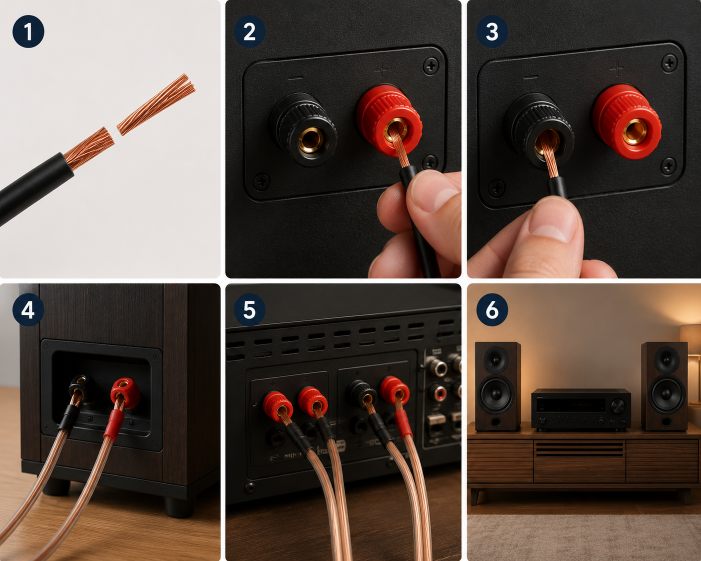
Most speaker terminals accept bare wire. Here is the method:
- Strip about 10 to 12 mm of insulation from each conductor.
- Twist the loose strands tight so none stick out. Stray strands can touch and short.
- Open the terminal. A binding post unscrews, and a spring clip presses in.
- Insert the wire and close the terminal firmly.
- Tug gently to check it holds.
Repeat for both conductors, on both the amplifier and the speaker.
Getting polarity right (+ and −)
This is the rule that matters most. Each speaker cable has two conductors, positive and negative. One side carries a marker: a stripe, a colour, printed text, or a ridge on the insulation.
Connect positive on the amplifier to positive on the speaker. Do the same for negative. Most terminals use red for positive and black for negative.
Reverse one speaker and it plays out of phase with the others. The bass goes thin and the sound loses focus. Match every pair the same way.
How to connect speaker cables to an amplifier or receiver
Amplifiers and receivers use one of two terminal types:
- Binding posts. Unscrew the collar, insert bare wire or a banana plug, then screw it back down.
- Spring clips. Press the tab, insert the bare wire, then release.
Keep each channel’s positive and negative matched. Route the left and right cables to the matching speaker outputs so the stereo image stays correct.
How to connect speaker cables to a TV
Here is the honest answer: most TVs cannot take speaker cable directly. A TV has no built-in amplifier for passive speakers. To run wired speakers with a TV, connect them to an AV receiver, an amplifier, or a soundbar with speaker outputs, then link that unit to the TV.
A few TVs with built-in amplification do have speaker terminals on the back. If yours does, connect the bare wire there the same way as on an amplifier. If it does not, you need a receiver or amplifier in between.
How to connect speaker cable to a banana plug
Banana plugs make a tidy, quick connection:
- Strip about 12 mm of wire.
- Loosen the plug’s screw collar, or open its crimp barrel.
- Insert the twisted wire into the plug.
- Tighten the collar, or crimp it closed.
- Push the finished plug into the binding post.
Use one plug per conductor, and keep red and black matched to positive and negative.
Speaker cable and RCA jacks: what to know
Speaker cable and RCA are not the same signal. RCA carries a line-level signal from a source to an amplifier. Speaker cable carries the amplified signal from the amplifier to the speaker. You cannot swap one for the other.
The one exception is a subwoofer with speaker-level inputs. Some subs accept speaker cable on spring terminals, though most use an RCA line input. Check your subwoofer’s manual before you wire it.
Common mistakes to avoid
- Stray strands. A single loose strand touching the other terminal can short the amplifier.
- Reversed polarity. One flipped pair thins the bass across the whole system.
- Connecting with power on. Always switch off first.
- Loose terminals. A slack connection crackles and cuts out, so tighten every one.
A clean, well-made speaker cable makes each of these easier to get right. For help matching cable to your system, talk to a Tono specialist.
Frequently asked questions
Can I connect speakers directly to a TV?
Usually no. Most TVs have no amplifier for passive speakers. Connect the speakers to a receiver, an amplifier, or a soundbar, then link that to the TV.
Should I use bare wire or banana plugs?
Both work. Bare wire costs nothing and is fine for a fixed setup. Banana plugs are tidier and quicker to swap.
How do I tell positive from negative on speaker cable?
Look for a marker on one conductor: a stripe, a colour, printed text, or a ridge. That side is your positive. Keep it consistent on every connection.
Do I need to solder speaker cables?
No. Twisted bare wire or a screw-on connector holds well. Soldering is optional and not needed for a normal setup.