Picking the right speaker cable for home theatre keeps every channel clear, from the front stage to the rear surrounds. The cable has to suit the run length, hide neatly, and connect cleanly to your AV receiver. This guide covers what to look for, what gauge each run needs, and how much to buy.
What makes a good home theatre speaker cable
When you choose speaker cable for home theatre, three things matter most:
- Gauge. Match thickness to the run. Short front runs are fine with 16 AWG, while long surround runs want 14 AWG.
- Copper quality. Oxygen-free copper (OFC) keeps resistance low and holds detail over the long runs a surround setup needs.
- Shape and routing. A flat cable hides under carpet or along skirting, while a round cable suits conduit and in-wall runs.
Get these right and the cable disappears into the room while the sound stays clean.
What gauge speaker cable for a home theatre?
A surround system has runs of very different lengths, so one gauge rarely fits every channel:
- Front left, right, and centre: usually short, so 16 AWG is plenty.
- Surrounds and rears: often run around the room, so use 14 AWG.
- Long ceiling or in-wall runs: step up to 12 AWG.
Not sure about your room? Use our speaker wire gauge calculator: enter each run length and it gives the gauge. The full method sits in the speaker wire gauge guide.
Flat or round cable for a home theatre?
Both shapes carry the signal the same way. The difference is routing.
A flat speaker cable sits almost invisibly under a carpet, along a skirting board, or beneath a rug. It suits a finished room where you cannot open the walls. The Tono Monochrome is a flat 99.99% OFC cable made for exactly this job.
A round cable suits conduit, trunking, or runs inside a wall, where the shape never shows.
In-wall and in-ceiling surround runs
Many home cinema setups hide the surround and ceiling cables inside the walls. For that, use a CL2-rated cable. The CL2 rating means the jacket meets fire-safety code for in-wall use, and a standard cable behind drywall is a risk.
The Tono Pro CI Series handles this job, in 14 and 16 AWG.
Wiring a 5.1 or 7.1 system
Each speaker gets its own pair of conductors back to the AV receiver. Keep two rules in mind:
- Match polarity. Positive to positive, negative to negative, on every channel. One reversed surround thins the whole soundfield.
- Label each run. Mark front, centre, and surround at both ends so the receiver’s outputs are easy to match.
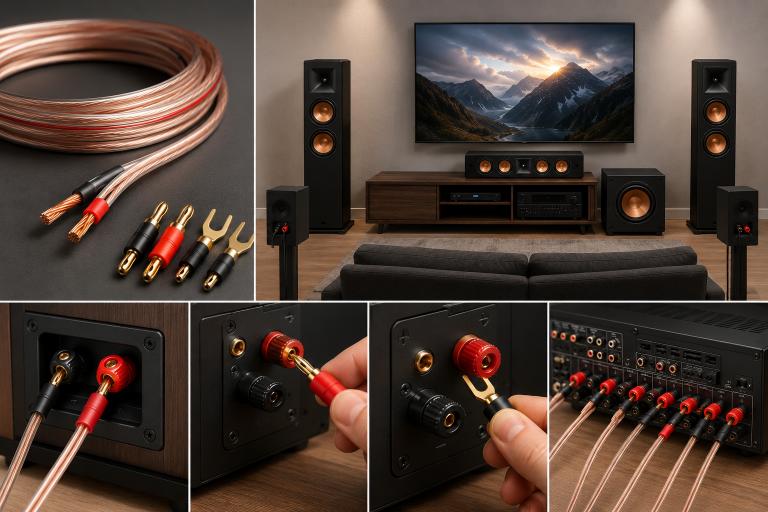
Most AV receivers take bare wire or banana plugs. The full method sits in our guide on how to connect speaker cables.
A note on “home theatre in a box” systems
Many all-in-one kits, including some Samsung home theatre systems, use proprietary connectors or thin captive wire. You often cannot simply swap the cable on those. If your system uses an AV receiver with standard speaker terminals, you are free to choose your own cable and gauge. Check the back of your receiver before you buy.
How much speaker cable to buy
Measure the run from the receiver to each speaker, following the route the cable will actually take, not a straight line. Add about 10% for slack and a service loop at each end. Buy a little more than the total, because offcuts are always useful. In the end, the best speaker cable for home theatre is the one matched to your runs and routed cleanly, not the priciest on the shelf.
Frequently asked questions
What gauge speaker cable is best for surround speakers?
14 AWG suits most surround runs, since they travel around the room. Short front runs are fine with 16 AWG, and long ceiling runs may want 12 AWG.
Is flat or round speaker cable better for a home theatre?
Both sound the same. Flat cable hides under carpet and along skirting in a finished room, while round cable suits conduit and in-wall runs.
Can I replace the speaker wire on a Samsung home theatre system?
Often not. Many all-in-one kits use proprietary connectors. If your system uses an AV receiver with standard terminals, you can choose your own cable.
Should I use banana plugs for a home theatre?
They help. With many channels, banana plugs make the receiver’s terminals tidy and quick to connect or swap.